
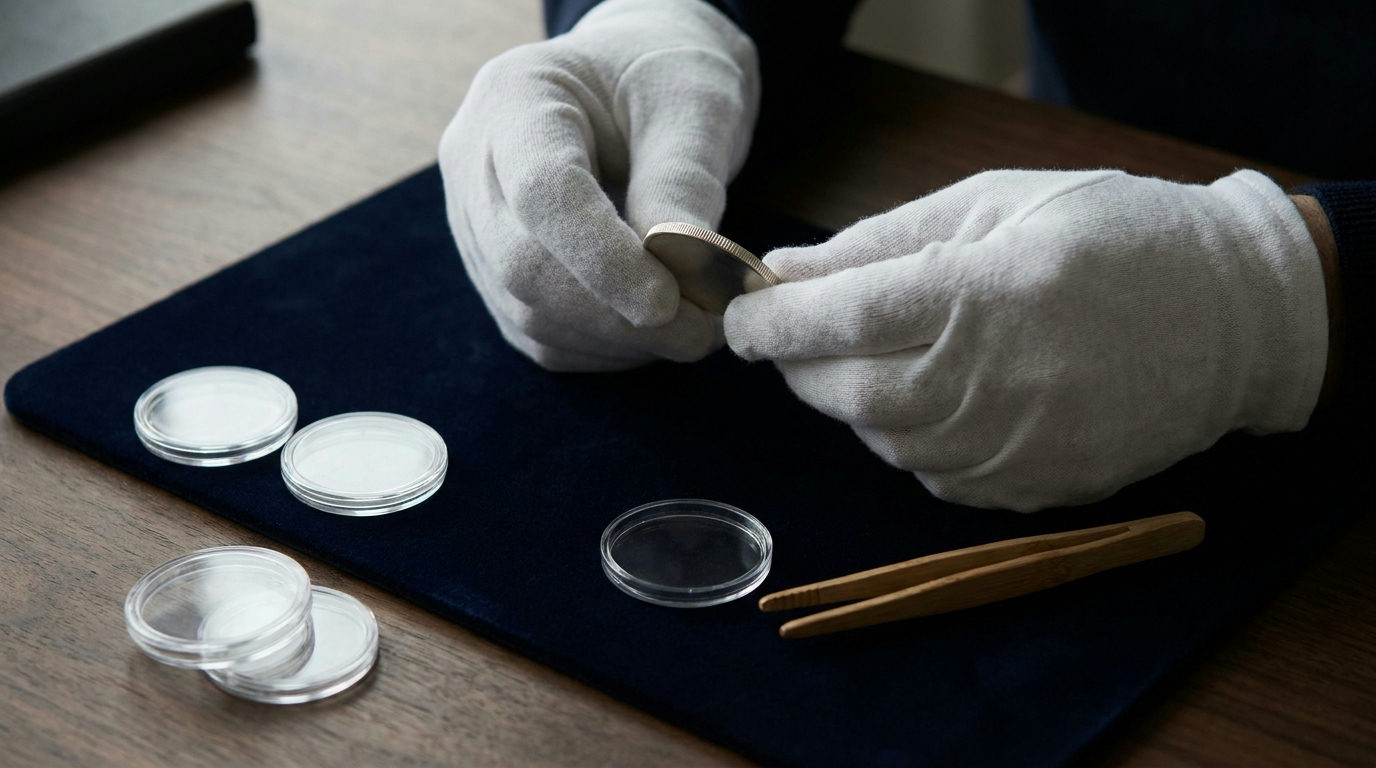
Gold and silver coins look tough, but their surfaces are surprisingly easy to damage. A fingerprint, a careless wipe, or the wrong storage sleeve can leave marks that are hard or impossible to undo. For bullion, damage mostly affects appearance and sometimes resale. For collectible coins, it can cut value sharply. Knowing how to care for coins properly takes only a few simple habits, and this guide covers them: handling, cleaning (or rather, not cleaning), storage materials, and what to do about tarnish.
This article is general education. It is not financial advice. Silver Gold Today may earn a commission from some links on the site; see our affiliate disclaimer.
Why coin care matters
A coin’s surface carries a lot of information. Collectors and graders look closely at luster, contact marks, hairline scratches, and toning. Dealers buying bullion also prefer clean, undamaged pieces, and some may offer less for coins that look mistreated. Even if you only care about metal value, a coin in good condition is easier to sell, easier to verify, and more pleasant to own.
The good news is that almost all coin damage is preventable. Most of it comes from three things: handling, cleaning, and poor storage.
How to care for coins when handling them
The oils and moisture on your skin can leave fingerprints that may become permanent marks over time, especially on silver and on coins with mirror-like proof finishes.
- Hold coins by the edge. Grip the coin between your thumb and forefinger on the rim, never on the flat faces.
- Use gloves for valuable pieces. Soft cotton or powder-free nitrile gloves keep skin oils off the surface. Some collectors prefer nitrile because cotton can occasionally snag or shed fibres.
- Work over a soft surface. Handle coins over a folded towel or padded mat, so a dropped coin does not hit a hard floor or table.
- Do not talk directly over coins. Tiny droplets from speech can land on the surface and leave spots on some coins over time. It sounds fussy, but serious collectors take it seriously.
- Handle less. The simplest rule is to leave coins in their holders unless you have a reason to take them out.
Why you should not clean coins
This is the most important rule in coin care, and the one most often broken. Cleaning almost always does more harm than good.
- Abrasion. Polishes, baking soda, toothpaste, and even soft cloths can leave fine scratches called hairlines. They may be invisible at first glance but obvious under magnification or bright light.
- Loss of original surface. Collectors value a coin’s original surface and natural toning. Cleaned coins often look unnaturally bright and are usually worth less to collectors.
- Chemical damage. Harsh dips and household cleaners can strip or etch the surface.
Grading services such as PCGS and NGC assess surface condition closely, and evidence of cleaning can count against a coin. If you think a valuable coin needs attention, ask a professional conservator or a reputable dealer before doing anything yourself.
For plain bullion coins bought mainly for metal value, cleaning matters less to value, but it still adds risk and rarely adds anything worth having. When in doubt, leave it alone.
Understanding tarnish and toning
Silver reacts with sulfur compounds in the air and darkens over time. This can show up as a light golden tint, rainbow colours, or dark grey and black patches. Collectors call attractive, even colour “toning” and some collectors value it. Uneven dark spots are usually less welcome.
Gold is much less reactive and does not tarnish in normal conditions. However, some gold coins contain other metals in their alloy, and spots can sometimes appear, often from contamination during production or handling.
The best approach to tarnish is prevention, not removal. Good storage slows it down considerably.
Storage materials that protect coins
The holder a coin lives in matters as much as how you handle it. Some common materials are safe; others can slowly damage coins.
Generally safe choices
- Hard plastic capsules. Rigid, airtight capsules sized to the coin are a popular choice for individual coins.
- Coin tubes. Rigid tubes made for a specific coin size are practical for bullion.
- Original mint packaging. Mint boxes, capsules, and sealed packaging are designed for the product and help resale.
- Grading service holders. Coins sealed by grading services are protected and should be left sealed.
- Archival-quality flips and albums. Look for products described as free of PVC and acids.
Materials to avoid
- Soft PVC flips. Some soft plastic holders contain PVC, which collectors widely avoid for long-term storage because it can leave residue on coins. Check product descriptions and replace old soft flips if you are unsure.
- Paper envelopes and cardboard. Some contain compounds that can speed up tarnish on silver.
- Rubber bands. Rubber can cause dark marks on silver.
- Loose storage. Coins loose in a bag or jar rub against one another and pick up marks.
The storage environment
Where you keep your holders matters too. Our guide on how to store gold and silver covers security; for condition, focus on the environment:
- Keep it dry. Humidity speeds up tarnish and spotting. A safe with a small desiccant pack, replaced or recharged regularly, helps.
- Keep it stable. Avoid places with large temperature swings, such as attics, garages, and spots near heaters, which can cause condensation.
- Keep it away from chemicals. Avoid storing coins near household cleaners, paints, or anything that gives off fumes.
- Check occasionally. Look at your coins once or twice a year without removing them from their holders, so you catch any problem early.
Getting the environment right is a big part of how to care for coins over the long term, because it works quietly in the background every day.
Common mistakes to avoid
- Polishing a coin to make it “look nicer” before selling.
- Handling proof coins with bare fingers.
- Storing silver in old paper envelopes or with rubber bands.
- Leaving coins in soft plastic flips for years without checking them.
- Breaking open a graded holder to “look at the coin properly.”
- Keeping coins loose in a jar where they rub together.
Frequently asked questions
Can I remove fingerprints from a coin?
Fresh fingerprints may sometimes be addressed by a professional, but home attempts often cause more damage. For valuable coins, ask a conservator or reputable dealer first.
Is toning bad for silver coins?
Not necessarily. Even, attractive toning can appeal to collectors. Uneven or very dark tarnish is usually less appealing. For bullion, toning rarely affects metal value.
Should I take coins out of mint packaging?
Generally, no. Original packaging protects the coin and can help with resale. Inspect through the packaging where possible.
Do gold coins need special care?
Gold is more resistant to tarnish than silver, but its surface still scratches. The same handling and storage habits apply.
The bottom line
Learning how to care for coins comes down to a few simple rules: handle by the edges, use gloves for valuable pieces, never clean coins yourself, store them in safe, inert holders, and keep them dry and stable. These habits protect both appearance and value, and they cost very little. If you are planning to sell, our guide on how to sell gold and silver explains why well-kept coins make the process easier.